

Many times, I sit across from a man in my therapy room and I am reminded that it's not all men.
I talk to other therapists and educators and I hear time and time again that it's not all men.
So if we know this to be true, why do we keep hearing "all men"?
The answer to this is relatively simple and also deeply sad.
Stories about fathers and brothers and teachers and friends and acquaintances and coworkers harming women in their lives remind us that even someone who feels safe — or should be safe — might not be.
And because women have to learn from a young age to protect themselves, it may be easier to assume that all men are bad until proven good.
I have been lucky enough in my personal life and in my therapy practice to know that there are men who are kind and loving and intelligent and joyful and who want to see others and to be seen.
And I happen to know that every single one of them has made mistakes.
Do their mistakes make them part of the "all men" group? I don't think so.
When I say mistakes, I mean things like a joke that crossed a line, a comment we didn't think twice about, or brushing someone off when they tell us how we affected them. I don't mean rape or sexual assault. I'll come back to where I draw that line.
Here's the TL;DR for what YOU can do
- Listen when women tell you how things have felt for them. Don't correct them, talk over them, or get defensive.
- If someone tells you that you hurt or scared them, apologize. "I'm sorry for the impact I had on you" — not "I didn't mean to."
- If a man around you talks about women in a disrespectful, objectifying, or outright violent way, say something. "Not cool, dude" is enough.
- Be honest with yourself about your own behavior. Everyone is shitty sometimes, and you have to learn to be accountable.
- Pressuring someone after she says no is sexual coercion. Holding her down, drugging her, or going ahead when she is too intoxicated or asleep to say yes is sexual assault. That takes more than "do better" — and I would encourage you to talk with a therapist.
Good Men, Evil Men, and the Gray Area
The graphic below depicts the difference between how men and women view the social environment of men.
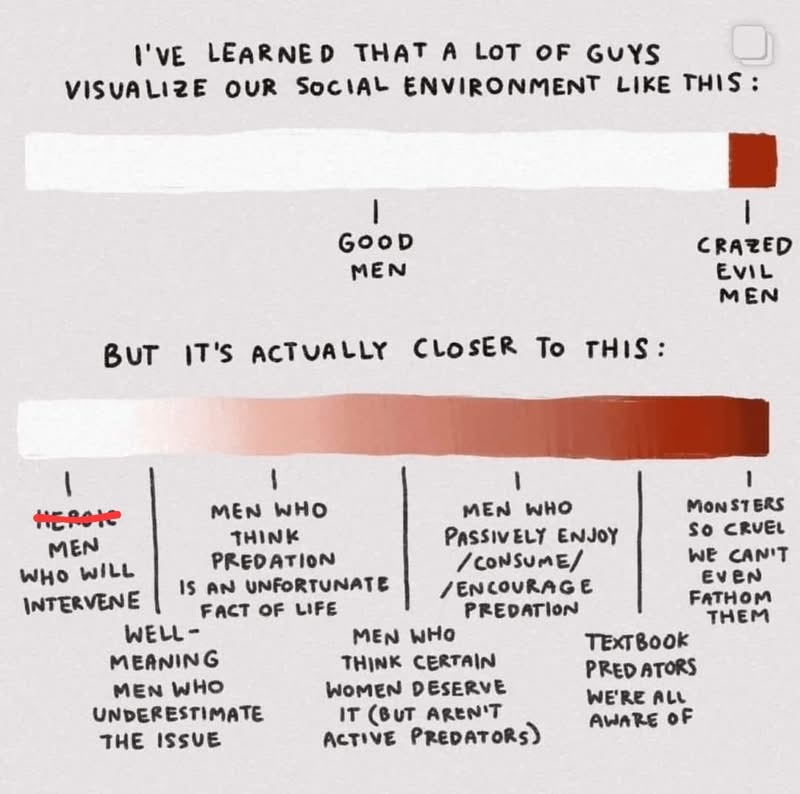
Graphic by @coinswallow on Instagram, included with permission.
And I suspect this graphic gives us some good information as to where the fear of being grouped into the "all men" category comes from.
If women believe that there is a spectrum of men from "men who will intervene" to "monsters so cruel we can't even fathom them," there must be a lot of gray area. Though there isn't research on this to my knowledge, I suspect the distribution would look like a bell curve, with the majority somewhere in the middle.
When women express anger or sorrow or hurt regarding not only the monsters, but also those who choose not to intervene, it follows that any acceptance of a mistake would feel like men are willingly admitting their membership to the "crazed evil men" category.
And I would think that the fear of association with that category leads to the defensiveness or avoidance that prevents us from showing empathy, connecting, and understanding.
And so, when confronted with their own mistakes or even commentary on other men's mistakes, many respond with phrases like this:
"Well that's not what I meant."
"I'm your husband/partner/boyfriend, so you should want that."
"He was just kidding, it was a joke."
Instead of saying something like:
"Wow, I didn't know I was impacting you that way. I'm sorry."
"It's horrible that things like that happen."
"Everyone deserves to feel safe and respected."
And why does this matter?
Well, there are a few reasons.
1. Women are also experiencing fear.
Many have learned to build their entire lives around everything they can do to keep themselves safe.
Don't bend over. Don't wear pigtails. Don't wear shorts. Or skirts. Or dresses. Or swimsuits.
Don't have a drink. Don't walk alone at night. Don't make a guy think you want it. Don't say no because they might hurt you more.
Carry your keys between your fingers. Or carry pepper spray. Or learn self defense.
And despite this, nearly 1 in 3 women have experienced physical or sexual violence.[1][2]
Most assaults don't happen in dark alleyways at night. They happen in places that women and girls feel safe, with people they believe they are safe with. Most victims of sexual violence know the person who harmed them.[3]
2. Many men don't see the harm.
A 2026 study of 2,689 self-identified men ages 18 to 34 in the US and Canada, who answered anonymously online, showed that 95.1% had used at least 1 of 36 identified strategies in the previous four years to get a woman who was unwilling and nonconsenting to have sex.[4]
In about two thirds of those situations, the men were successful.
It helps to know what those strategies were. The most common was telling her whatever she wanted to hear (78.1%), followed by asking her repeatedly (48.6%).
62.6% of the men reported using none of the 12 most forceful strategies, which range from yelling at her and shaming her to restraining her and drugging her. The other 37.4% reported using at least one. Roughly 1 in 10 reported each of the most overt: overpowering her, restraining her, or using drugs.[4]
The study did ask the men what came of it. Most said "nothing bad." Only 74 of 2,254 mentioned feelings of their own like guilt or shame, and just 7 mentioned that the woman was traumatized.[4]
I can't help but wonder if this was the first time many of them had considered if what they did was wrong.
And while my heart is aching for the girls and women in my life, I wonder how many of those boys and men ever learned that they could take accountability for what they did and come back from it.
In a culture where it feels like one misstep could lead to being cancelled, fired, humiliated, or ostracized, how can we have accountability?
3. The boys are not okay.
While controversial, the "male loneliness epidemic" has shined light on a few things that I think are relevant.
Pew found that men and women say they feel lonely at similar rates, but men turn to fewer people for emotional support.[5]
So how does this connect to the "not all men" situation? We teach men that they are not allowed to have feelings.
Maybe someone brings up an issue to them or they see something online that lands wrong. But they aren't allowed to feel sad or hurt or insecure or guilty.
And so, two things happen when these feelings come up (and they do):
- They are bottled up or thrown at others with rage. (defensive or avoidant)
- Men try to share and are met with shame or ridicule. (reinforcing the first as the only real option)
And so they push connection further away.
What you can do
And if you've made it this far, you might be wondering what you can do with all of that information.
You probably aren't in a position to step in and protect a woman experiencing assault right this moment. Maybe you never have been.
But I guarantee that you have had experiences around men who talked about women in a disrespectful, objectifying, or outright violent way. Or that you have had experiences where you did some of those things.
Note: I wanted to insert a statistic here about what percentage of men commit sexual assault, but the honest answer is that it depends on how you ask. Studies of men who can be identified generally find self-reported rates between 8% and 24% since age 14, depending on the behavior measured. The anonymous survey I mentioned earlier found much higher rates, and its list included pressure tactics as well as force.[4]
So the information I'd like to provide to you is this: I have many women in my life who have experienced rape, sexual assault, or even unwanted touching — and I don't personally know a single person who has felt safe enough to report.
1. Listen to the women you have in your life.
If the women around you feel safe enough to share with you, listen to them. Here are some things you can ask:
- Is there anything that I do that feels unsafe?
- Are there men in your life who feel unsafe?
Listening to their experiences without correcting them, talking over them, or becoming defensive is a good opportunity to learn about the impact that you or men you know have on women's safety and well-being.
The people closest to you will be the ones who are best able to help you see where you can make changes — if you can be humble enough to hear them.
2. Take accountability.
When you read some of the behaviors I have listed in the next section, you might feel confused, guilty, frustrated, or even angry.
I am not asking you to go to everyone you have ever done these behaviors around and apologize to them.
If someone specifically brings up a situation where they felt unsafe or hurt by you, apologize. That means "I'm sorry for the impact I had on you" — not "I didn't mean to."
But in either case, whether you are looking back on your own behavior or someone has brought it up to you, what you need to do is be honest with yourself.
If you feel guilty, that is not a bad thing. Usually, guilt tells us that the way we have acted is not in line with who we are. And if we allow ourselves to feel it, we can use it to change.
This can be an immensely difficult task and I am not asking this of you lightly. If you struggle with either of these tasks — and many people do — I would encourage you to find a therapist who can help you in this process.
3. Look at your own behaviors.
If you grew up in America, you have experienced conditioning around the power imbalance between men and women. This means you have probably said or done some things you aren't proud of.
And I just want you to hear two things clearly: everyone is shitty sometimes AND you have to learn to be accountable.
Here is a non-comprehensive list of behaviors that are not sexual assault, but are harmful and perpetuate a culture of violence towards women:
- Objectifying: sexualizing specific body parts, referring to a woman by her sexual attributes, ignoring any aspect of her personality, job, intelligence, or capability.
- Interpersonal Disrespect: catcalling, inappropriate comments, gawking or staring for prolonged periods of time.
- Controlling or Abusive Behavior or Intent: statements around physically harming your partner or taking away their choice, telling your partner they can't go somewhere, see someone, or wear something.
As mentioned, this is not a comprehensive list, but it is a place to start.
I also want to be clear about where the line is. A joke that crossed a line, a comment you didn't think twice about, or brushing someone off when they tell you how you affected them are mistakes you can own and learn from.
Pressuring someone after she has said no is sexual coercion. Holding her down, drugging her, or going ahead when she is too intoxicated or asleep to say yes is sexual assault. The study I mentioned earlier lists many of these tactics.[4]
If you recognize yourself in that, "do better" is not enough. I would encourage you to talk with a therapist about it.
4. Say something when other men participate in the above behaviors.
I suspect that this is going to feel like the biggest ask.
I know that it feels scary to stand up to friends, peers, colleagues, family members who might laugh, ignore, or even reject the correction. If you were to say "not cool, dude" or even "hey, knock it off," they might brush it off as a joke or even attack you with insults.
And although I know it would hurt, the women in your life and in their lives need you to do it anyway.
This is another situation where you may realize you need more support and choose to find a therapist.
If therapy isn't an option right now
If you want support but therapy isn't an option for you right now — whether because of cost, access, or not being ready — here are some places to start:
- Books: I Hear You by Michael S. Sorensen is a short guide to validation — the skill of helping someone feel heard without arguing with them. For the Love of Men by Liz Plank looks at how expectations of masculinity affect men and the people around them.
- Low-cost therapy: Open Path Collective connects people who are uninsured or underinsured, with a household income under $100,000, to therapists for $40 to $70 per session after a one-time $65 membership fee.
- Free peer support: ShareWell hosts free online peer support groups.
- If you are in crisis: call or text 988 in the US.
Final Thoughts
So maybe I am angry too.
But every time I start to wonder if the problem is truly every single man on the planet, I am reminded that we are a product of a system that hurts girls AND boys and that turns us into victims and perpetrators.
And while a harmful system does not absolve anyone of the decisions that they have made, maybe it can help us to find compassion for ourselves and others.
And maybe there is a cure in that.
If you need extra support, book a consult and we can see if I might be a good fit. If we aren't, I will be happy to support you in finding someone who is!
Book a Free ConsultationSources
- World Health Organization. Violence against women (fact sheet). Version dated June 18, 2026.
- World Health Organization. Violence against women prevalence estimates, 2023: global, regional and national prevalence estimates for intimate partner violence against women and non-partner sexual violence against women. Geneva: WHO; 2025.
- Basile KC, et al. The National Intimate Partner and Sexual Violence Survey: 2016/2017 Report on Sexual Violence. Centers for Disease Control and Prevention; 2022.
- O'Sullivan LF, Ronis ST. Isolate, inebriate, intimidate, repeat: high rates of sexual force against women are reported when young men given anonymous surveys. Journal of Interpersonal Violence. 2026.
- Pew Research Center. Men, Women and Social Connections. January 16, 2025.